Onam Festival: Kerala's Biggest Harvest Festival (2026 Guide)
If there's one festival that explains Kerala to itself, it's Onam. Onam festival in Kerala is celebrated by Hindus, Christians, and Muslims alike and its roots reach back to the region's agrarian calendar rather than any single temple tradition. For ten days each year, homes get repainted, flower carpets grow a little larger each morning, families travel home from across India and the world, and kitchens across the state prepare a feast that can run to more than two dozen dishes on a single banana leaf. Onam is Kerala's answer to what a harvest festival can be when an entire culture decides to build itself around it.
When Is Onam Festival? 2026 Dates
Onam follows the Malayalam solar calendar rather than a fixed Gregorian date, so it shifts slightly from year to year, though it consistently falls in the Malayalam month of Chingam, which overlaps with August and early September.
Onam 2026 runs across ten days, beginning with Atham on August 17 and culminating in Thiruvonam, the main day, on Wednesday, August 26, 2026. If you're planning a trip specifically to experience the festival, treat the final three or four days from Uthradom through Thiruvonam as the period with the most visible celebration, since that's when the pookalam designs, the Sadya, and most public events reach their peak.
The Legend Behind the Festival
Onam commemorates the annual homecoming of King Mahabali, a mythological asura (demon-clan) ruler whose reign over Kerala is remembered as a golden age of prosperity and equality a time, according to the old Malayalam saying, when "everyone was equal, and there was no theft, deceit, or falsehood."
Mahabali's popularity became a problem for the Devas (gods), who grew uneasy at his growing power and appealed to Lord Vishnu for help. Because Mahabali was himself a devoted follower of Vishnu, Vishnu chose not to confront him in battle. Instead, he took the form of Vamana, a Brahmin dwarf, and approached Mahabali during a ritual sacrifice, asking for only as much land as he could cover in three paces.
Mahabali agreed. Vamana then grew to cosmic scale, covering the entire earth in his first stride and the heavens in his second. With nowhere left to place his third step, Mahabali recognizing Vishnu's true form offered his own head. Moved by the king's humility and devotion, Vishnu granted him a boon: he could return to visit his people once every year. That annual visit is what Onam celebrates, and the festival's central emotional thread decorating homes, preparing a great feast, dressing in new clothes is essentially Kerala getting ready to welcome a beloved former king back for a single day.
A Brief History
Onam's origins predate its current form by a long stretch. References to Onam-like harvest celebrations appear as far back as the Sangam era, and there are more concrete historical records of the festival being celebrated during the reign of the Kulasekhara Perumals, around the 9th century CE, when the entire month of Chingam was reportedly treated as an extended Onam season. Over the centuries it evolved from a purely agrarian celebration into the broad cultural institution it is today one that functions as much as a homecoming and family reunion as a religious or harvest observance.
The Ten Days of Onam
Traditionally, Onam unfolds across ten named days, each tied to a specific nakshatra (lunar asterism) in the Malayalam calendar:
Atham — The festival's opening day, when the first small pookalam (flower carpet) is laid at the entrance of homes.
Chithira
Chodhi
Vishakam — Markets and shopping districts get noticeably busier as households begin preparing for the main event.
Anizham — Traditionally associated with the start of snake boat race practice and preparations in boat-race villages.
Thriketta
Moolam
Pooradam — Homes are typically cleaned and decorated in earnest by this point.
Uthradom — Known as "First Onam," this is when most of the Sadya shopping and cooking preparation happens, and many families traveling home try to arrive by this day.
Thiruvonam — The main day. This is when the grandest Sadya is served, new clothes (Onakkodi) are worn, and the festival reaches its peak.
Some regions and families extend celebrations for a few additional days after Thiruvonam, referred to as Third Onam and Fourth Onam, with slightly quieter family gatherings and leftover feasting.
The Traditions That Define Onam
Pookalam
The pookalam is a floral carpet laid at the entrance of homes, traditionally made from flower petals arranged in concentric, symmetrical patterns. It starts small and simple on Atham often just a single ring and grows larger and more elaborate each day, reaching its most intricate form on Thiruvonam. The pookalam is meant to welcome Mahabali home, and pookalam-making has become a genuine competitive art form, with organized competitions held across the state during the festival.
Onam Sadya
No description of Onam is complete without the Sadya a vegetarian feast served on a banana leaf that can include anywhere from a dozen to nearly 30 dishes in a single sitting. Sambar, avial, thoran, olan, kalan, pachadi, pickles, pappadam, and multiple varieties of payasam are all standard components, arranged in a specific order on the leaf and eaten in a deliberate sequence, generally moving from milder flavors toward the richer, sweeter dishes at the end. Restaurants across Kerala run special Onasadya menus during the festival period, some offering as many as 25-30 items.
"For the full dish-by-dish breakdown, see our guide to Kerala's vegetarian dishes."
Onakkodi
Literally "Onam clothes," this refers to the tradition of buying and wearing new clothing for the festival, usually the traditional mundu and set-mundu (a two-piece white-and-gold garment), particularly on Thiruvonam itself.
Pulikali
One of Onam's most visually striking traditions: performers paint their bodies in bright tiger and hunter designs and dance through the streets to the beat of traditional percussion. Thrissur hosts the most famous Pulikali procession, typically held on the fourth day after Thiruvonam, drawing large crowds specifically for the spectacle.
Vallamkali (Snake Boat Races)
Kerala's snake boat races cluster heavily around the Onam season, and two of the most significant the Aranmula Boat Race and the Payipad Boat Race are directly tied to Onam-period temple traditions. (The Champakkulam Boat Race, by contrast, opens the season earlier, in late June or July, ahead of the main Onam-linked races.) Long chundan vallams, or snake boats, crewed by over a hundred rowers, race to the rhythm of vanchipattu boat songs one of the most physically dramatic sights in Kerala's festival calendar.
Athachamayam
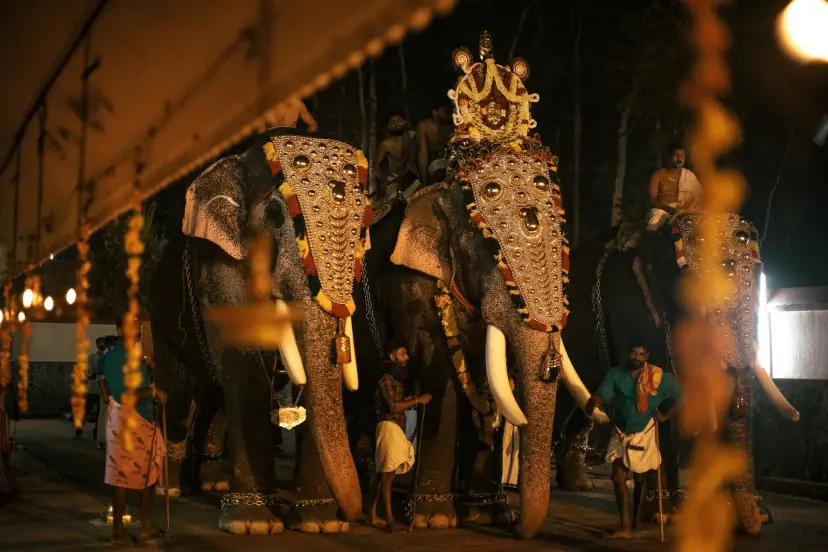
Held in Thripunithura, near Kochi, on Atham day itself, this colorful procession is often described as the official curtain-raiser for the Onam season, featuring elephants, folk performers, and traditional music, and is considered one of the largest Onam-related public processions in the state.
Kaikottikali and Thiruvathira
Traditional dance forms performed by women, typically in a circle around the pookalam or a lit lamp, accompanied by rhythmic clapping and folk songs a common sight at community and family Onam gatherings.
Onam Beyond Kerala
Because a substantial Malayali diaspora lives outside Kerala across India and internationally, particularly in the Gulf states, the UK, the US, Canada, and Singapore Onam is widely celebrated wherever Malayali communities have settled. Community associations abroad typically organize their own Sadya events, cultural performances, and pookalam competitions, often scheduled around the nearest weekend rather than the exact festival date, so the celebration can extend well beyond the ten official days if you're tracking events outside Kerala itself.
Planning a Visit for Onam
If you want to experience Onam as a traveler rather than just read about it, a few practical notes:
Book well ahead. Onam is peak domestic travel season within Kerala, as much of the Malayali diaspora returns home for the festival. Accommodation in Kochi, Thrissur, and Alappuzha fills up fast in the final week before Thiruvonam. If you're planning the trip as a couple, see our Kerala Honeymoon Packages for houseboat-and-hill-station routes timed around the festival season.
Time your trip around Uthradom through Thiruvonam if your primary interest is the Sadya and pookalam displays, since that's when celebrations are at their most visible.
Head to Thrissur for Pulikali, held a few days after Thiruvonam, if the tiger-dance procession is a priority.
Head to Aranmula or Payipad if snake boat racing during the Onam period specifically is what you're after, since these fall within the festival window, unlike Champakkulam's earlier-season race.
Try an Onasadya even if you're not staying with a local family most mid-range and upscale restaurants across Kerala run a special festival menu during the ten-day period, and it's one of the more accessible ways to experience the feast as a visitor.
Final Thought
Onam works because it operates on two levels at once a specific, well-loved myth about a just king's annual homecoming, and a genuinely universal harvest celebration that doesn't require anyone to share a particular faith to take part in it. Whether you experience it through a single Sadya meal, a pookalam competition, or ten full days immersed in Kerala during its most festive stretch of the year, it's the clearest window available into what the state values: hospitality, abundance, and a fairly serious commitment to feeding everyone at the table.
Frequently asked questions
Is Onam a religious festival or a harvest festival?
What is the most important day of Onam?
How many dishes are typically served in an Onam Sadya?
Do I need to be Hindu to celebrate or attend Onam events?
What is Onam festival?
Is Onam a public holiday?
About the author
Amit Aswal
Amit Aswal writes TravelBudie, drawing on years working in travel and hospitality and on trips he plans and takes himself. Destination guides and itineraries are based on firsthand travel. Visa, entry and regulatory guides are researched against official government sources and re-verified on a published schedule, and each one shows the date it was last checked.
Stay in the loop
Enjoy our travel stories? Add Travelbudie as a preferred source on Google.
You'll see more of our guides and tips when you search for travel inspiration.
Add as a preferred source on GoogleYour trip, your way
Ready to turn inspiration into an itinerary?
Tell us your dates, budget, and travel style — our team will craft a personalised trip plan built around what matters to you.
Your trip, your way
Ready to turn inspiration into an itinerary?
Tell us your dates, budget, and travel style — our team will craft a personalised trip plan built around what matters to you.
Travel inspiration
Get guides & deals in your inbox
Destination tips, seasonal itineraries, and exclusive offers — no spam, unsubscribe anytime.